Posts

Showing posts with the label Drug

Drug Storage

Image
Introduction Once, I received a query from a ward nurse: If a product label mentioned that "Do not store over 25°C", is it fine for us to keep the medication in fridge? What does a cool place on the product label mean? Tips for Patients Storing medication properly is important to ensure it works as intended to prevent poisoning accidents. Read the label to know the recommended storage temperature range. Always keep medicine in its original container . Keep out of reach and sight of children. Store medicines a cool, dry place . Heat, air, light and moisture may damage medicine. Do not store medications at Car for long hours - due to exposure to high heat Bathroom cabinet - due to the and moisture and shower Near stove or microwave at kitchen - due to heat and moisture Fridge, unless instructed in product leaflet. Once the medication bottle is opened, the cotton and desiccant must be discarded as they pull moisture into the bottle. Importantly, do not take medicine that h...

How Drugs Act?

Image
Introduction A drug can be defined as a chemical substance of known structure, other than a nutrient or an essential dietary ingredient, which, when administered to a living organism, produces a biological effect . 4 main kinds of regulatory protein are commonly involved as primary drug targets , namely: receptors, enzymes, ion channels and carrier molecules (transporters). For a drug to be useful as either a therapeutic or a scientific tool, it must act selectively on particular cells and tissues (i.e. high degree of binding site specificity). However, no drugs are completely specific in their actions . In many cases, increasing the dose of a drug will cause it to affect targets other than the principal one, and this can lead to side effects . NOTE: Many drugs bind (in addition to their primary targets) to plasma proteins and other tissue proteins, without producing any obvious physiological effect. Drug Receptors In pharmacology, receptor describes protein molecules whose function...

Drug Nomenclature

Image
Introduction Drug nomenclature has evolved over time. In the past, drug names were formed by condensing their chemical names. Types of Drug Nomenclature Most drug entities are known by several chemical names, code number, several trivial designations, a formally selected nonproprietary name, and one or more proprietary (trademark) names. Code name - The first name given to a drug by the manufacturer during the early product development. It is usually a letter abbreviation, a number or a combination of both. Chemical names - Scientific names of the drug based on the arrangement of atoms in their molecules and their functional groups (molecular structure). Generic or nonproprietary names - Names given to drug molecules after they have shown significant efficacy, tolerability and commercialization potentials. The name is usually simple, concise and meaningful. Proprietary, trade or brand names - Names given by the innovator company of the drug. The first letter of the trade name is w...

Paediatric Drug Dosing

Introduction Still vivid in my mind, when comes to paediatric dosing, we should not treat a child as a "mini adult". As children mature physically, their physiological systems develop at varying rates. In general, absorption, plasma protein binding, metabolism and excretion are lower in children. Hence, maintenance dosage (on a mg/kg/day basis) are generally smaller than those of adults. Whenever possible, medicines for children should be prescribed within the terms of marketing authorization (product license). However, in reality, many drugs are used off-label for the neonate and paediatric population. There is a helpful description of what "off-label" means for children and parents on the Medicines For Children website. References Besides product leaflets, commonly used drug dosing references for neonates and pediatrics are Malaysia: MIMS Malaysia , Paediatric Protocols for Malaysian Hospitals 2025 United States: Lexicomp , Micromedex (Drug Reference, Pediatric...

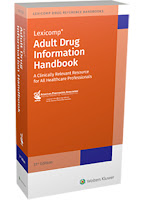
Lexicomp Drug Information Handbook

Image
Introduction Undoubtedly, Lexicomp Drug Information Handbook is a great reference to have. The 32nd edition has 1444 drug monographs, each offering up to 32 fields of information specific to a particular medication. The same drug information content can be found at UpToDate , but with missing information in Storage/stability Preparation for Administration Extemporaneously Prepared Mobile Application: UpToDate Lexidrug (formerly Lexicomp) In response to the industry's call for unified solutions, Lexicomp is renamed to UpToDate Lexidrug starting March 2024. Its mobile application provides a faster drug information searching and more intuitive drug interaction checker. Handy Tips When viewing drug monographs, you should use the "JUMP" button on the top right corner for faster navigation. In the Text Size menu under Preferences , you may adjust the text size of drug monograph to have a better overall visual experience. In the Settings menu under Preferences , you may op...

Drug-Food Interactions

Image
Introduction Drug-food interactions Are predominantly due to the effect of food on the absorption of the drug (e.g. food and bisphosphonate , antibiotics and iron tablets). May refer the list of medications that should be taken before, with or after food for more examples. Food can affect the metabolism of drugs by acting as an inducer or inhibitor of enzymes (e.g. grapefruit inhibits CYP3A4). Food can also enhance effects or side effects of drugs ( e.g. sedation with alcohol) or counteract the effect of drugs (e.g. Vitamin K and warfarin). NOTE: You may find food interactions in Lexicomp drug monograph. More Examples Summary Different from how we approach drug-drug interactions , we cannot conduct an assessment with drug-food interactions because a patient's complete diet history is incomplete . On the other hand, we shall educate patients on potential drug-food interactions to minimize the risk. External Links MyHEALTH - Food-Drug Interaction Dangerous Food-Drug Interactio...

Drug Dosing

Image
Introduction It may sound laughable when a fresh pharmacy graduate asked you, is the dosing of a particular drug to give half a tablet or two tablets a day acceptable or not. After working for a while, you probably realise not all drugs should be dosed one tablet a day (though lots of them are). Many years later, with experience, you may also become familiar with most common drugs dosing. However, before becoming a senior pharmacist, we should learn on drug dosing by actively checking drug references. When we are dispensing medications to patients, it is better to check each time whenever you are in doubt. Once the medication is dispensed, we bear part of responsibility. References Ideally, we would like to have a single extensive medicine reference exists which covers all the drugs marketed in Malaysia. But, it does not exist, not even MIMS Malaysia . This is because the list of drugs marketed in each country is slightly different. Nonetheless, the commonly used drug references are ...

Dosing in Obese

Image
Introduction I can still recall a memorable incident during my provisional registered pharmacist year when I received a phone call from a doctor during an on-call shift. The question seemed simple enough: whether dosage adjustments were needed for metronidazole in obese patient. However, even today, we are still in the stage of figuring best ways to dose obese patients. We are well aware that significant variations in pharmacokinetic and pharmacodynamic responses can occur among patients due to factors such as weight, age, genetics, concurrent diseases and other factors. However, the "one dose fits all" (all patients receive the same dose) remains a common form of drug dosing. Understanding Obesity Body size is typically defined using the body mass index (BMI) classification . Normal weight 18.5-24.00 kg/m 2 Overweight 25-29.99 kg/m 2 Obese class I 30-34.99 kg/m 2 Obese class II 35-39.99 kg/m 2 Obese class III ≥40 kg/m 2 NOTE: Caution must be exercised when applying BMI to ...

Prescribing in Hepatic Impairment

Image
Introduction Liver disease may alter the response to drugs in several ways, and hence drug prescribing should be kept to a minimum in all patients with severe liver disease. The main problems occur in patients with jaundice, ascites , or evidence of encephalopathy. Impaired Drug Metabolism Metabolism by the liver is the main route of elimination for many drugs, but hepatic reserve is large and liver disease has to be severe before important changes in drug metabolism occur. Routine liver-function tests are a poor guide to the capacity of the liver to metabolise drugs, and in the individual patient it is not possible to predict the extent to which the metabolism of a particular drug may be impaired. A few drugs, e.g. rifampicin and fusidic acid, are excreted in the bile unchanged and can accumulate in patients with intrahepatic or extrahepatic obstructive jaundice. Hypoproteinaemia The liver is the main source of synthesis of plasma proteins (e.g. albumin). The hypoalbuminemia in sever...

Drug Metabolism

Image
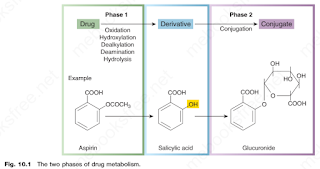
Introduction Since lipophilic substances are not eliminated efficiently by the kidney, most lipophilic drugs are metabolized to more polar products before excreted in urine. Liver is the principal site of drug metabolism, although other organs are involved (e.g. gut, kidneys, lung, skin and placenta). Phase I and Phase II Reactions Drug metabolism involves 2 kinds of reaction, which often occurs sequentially. Phase I reactions (e.g. oxidation, reduction or hydrolysis) are catabolic, and the products are often more chemically reactive. Phase II reactions are synthetic ("anabolic") and involve conjugation (i.e. attachment of a substituent group), which usually results in inactive products. The P450 Monooxygenase System The Cytochrome P450 system comprises 57 isoenzymes , each derived from the expression of an individual gene. The nomenclature comprises a family number, a subfamily letter, and a number for an individual enzyme within the subfamily. Each cytochrome 450 isoen...

Drug-Induced Photosenstivity

Image
Introduction Photosensitivity induced by exogenous agents refers to a process in which chemicals or drugs that are ingested or applied to the skin promote a photosensitivity reaction when the individual is exposed to sunlight. In one study , photosensitivity was responsible for approximately 20% of adverse drug reactions in elderly . Photosensitivity reactions can be classified according to the underlying mechanism or pathogenesis of the reaction into either Phototoxicity Most common form Results from direct tissue or cellular damage following ultraviolet (UV) irradiation of a phototoxic agent that has been ingested or applied to the skin. Phototoxicity can occur in any individual in whom the threshold concentration of the chemical or drug has been reached . Appear as an exaggerated sunburn . Typical photosensitivity reactions may result in the development of erythema, oedema and papules, and in severe cases, may also progress to the development of plaque-like urticarial lesions and p...