Pharmacist as Career
Introduction

When I chose pharmacy as my future career in secondary school, I had little idea of what I had actually signed up for.
- In my grandmother's simple description, it was an officer sitting inside an air-conditioned room, telling patients or customers how many tablets to take and how many times a day.
- Or, in a netizen's description, it was a high-paying job that merely involved putting medications into plastic envelopes and pasting medical instruction labels on them.
- Beyond the physical tasks, there are constant clinical decisions, critical thinking, and dosage verifications happening in our brains.
- We share a portion of the responsibility when medication errors inevitably occur at any stage.
As a practicing pharmacist of more than ten years, I can frankly tell you that most pharmacists working in government clinics and hospitals earn a stable but moderate income.
- You are not going to be a millionaire anytime soon; this profession is not a portal to great fortune.
- Only if you genuinely want to help people in need and have a true passion for being a healthcare professional should you pursue it.
- You could potentially earn more working in the community setting (especially as a pharmacy owner) or in the corporate pharmaceutical industry.
- Ultimately, you can be paid either a steady wage or a commission based on sales, depending on the role.
- Corporate jobs within multinational companies that involve managerial hierarchies can often be much more lucrative.
Hence, if any juniors are considering joining this clinical profession, I would seriously urge them to ask themselves if it is truly their passion.
- It requires thorough consideration beyond the illusion of an easy, glamorous job.
- At the end of the day, while struggling with the workload, we sometimes just wish for a decent wage to compensate for our emotional stress and fatigue.

Pharmacist Contract System at Malaysia
Since the introduction of the contract system for pharmacists, fewer than half of all graduates have been offered permanent positions in government facilities. This has understandably caused frustration and anxiety among future pharmacists.- The government's limited budget has severely hampered efforts to hire more healthcare professionals.
- The situation is further complicated by the proliferation of universities offering medical course - leading to a surge in medical graduates - paired with a disproportionately slow increase in number of new government healthcare facilities and job positions.
- This imbalance directly contributed to "Code Black" protest in July 2021.
In an attempt to address the issue, former Health Minister Khairy Jamaluddin announced in February 2022 that the cabinet approved the creation of 8686 additional posts for medical, dental and pharmaceutical officers between 2022 and 2025.
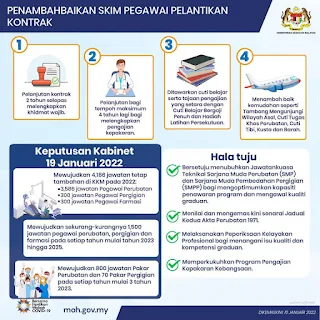
The debate surrounding the contract system for healthcare workers (including doctors, dentists, and pharmacists) in Malaysia is likely to resurface in the future.
- It is important to acknowledge that the days of guaranteed permanent positions for all healthcare professionals are likely over.
- For future pharmacists, it is crucial to consider career opportunities beyond government hospitals and clinics.
- Additionally, I hope for the implementation of fair, clear and transparent selection criteria for permanent positions, along with standardized scoring across all facilities.
Despite these challenges, there is a glimmer of hope.
- Deputy Health Minister Lukanisman Awang Suani announced on 24 June 2024 that a new permanent appointment method (subjected to performance and approval of the head of department) would be implemented once the review of the new Public Service Remuneration System (SSPA) was completed.
- However, as of late 2025, over 700 contract pharmacists lost their "reserve" status because permanent posts were capped at 600. The Health Ministry has stated that a new round of applications for permanent positions will be opened next year.
- While government hospitals and clinics strive to provide better and more comprehensive clinical services, there is a constant, underlying risk of severe staff shortages. This is because contract staff can easily leave whenever they find better job opportunities.
- Furthermore, the uncertainty and inherent insecurity of the contract system have driven many bright doctors and pharmacists to resign from government positions the moment they complete their professional training.
- If this situation remains unresolved, I am deeply concerned about the future. By the time I grow old, there will likely be a massive gap in the healthcare system, leaving a severe lack of motivated and capable professionals to take over as the current generation ages and retires.
Career Prospect in Public Service and The Way Forward

According to a Malaysia Pharmacist Salary Survey involving 232 pharmacists, there exists a "point of no return" for government pharmacists when they reach UF 12 grade under the SSPA system 48 (formerly UF 48, typically achieved after 7 years of service).
- At this point, our salary is finally comparable to that of community pharmacists, and we become too comfortable in our current roles.
- In many ways, we appreciate the predictability of coming to work and going home at 5:00 PM every day.
- We also face stiff competition if we try to secure a higher salary elsewhere.
- Consequently, we tend not to consider changing occupations unless presented with a compelling reason.

In terms of professional development, pharmacist specialisation is still in its early stages of recognition.
- In government service, achievements like passing the BCPS examination or completing a Master of Business Administration (MBA) do not yet guarantee promotions or salary increments.
- Similar to most countries, a Master in Clinical Pharmacy or a PhD is preferred, whereas passing BCPS examination is often viewed merely as a personal milestone.
- Therefore, the decision to undertake the BCPS examination should be carefully weighed against one's individual financial situation.
- The Malaysia Advanced Clinical Pharmacy Programme (MyACPP) is currently being developed to shape the future of clinical pharmacy in Malaysia.
In this era, online Continuous Medical Education (CME) and webinars are already the new norm.
- The MOH could develop a centralized website serving as a free platform for training courses. This would provide wider accessibility to pharmacists across all MOH facilities and allow them to learn at their own pace.
- Gone should be the days when only a select few from each facility could attend physical courses.
The reshuffling of pharmacists should be driven by staff requests and hospital needs rather than rigid, 10-year routine cycles. To advance the profession, we must prioritize specialization.
- We should not undervalue the specialized knowledge, experience, and skills a pharmacist acquires after years of dedicated service in a specific field.
- Furthermore, clinical pharmacists who prefer patient care over administration should be allowed to continue their clinical work.
- Forcing specialists into management roles solely based on seniority risks the loss of their expertise; Subject matter experts quickly become outdated when they are away from the wards.
However, high specialization in silos restricts our broader understanding of the profession, preventing us from seeing how pharmacy enforcement and logistics operate.
- Rotating pharmacists through diverse areas - such as government hospitals, clinics, and enforcement units - provides a broader perspective.
- Staying in a single dispensing role for too long can hinder our ability to train junior staff and limit professional growth.
- By breaking out of silos, we can better understand the collective challenges of the pharmacy ecosystem and propel the profession forward together.
- Only then can we tackle issues from the ground up in unison.
- In fact, making policy based on outdated working experiences is highly dangerous because we tend to forget the struggles faced on the ground.
Retail Settings
In retail settings, pharmacists are often the first point of contact for patients seeking medical advice.
- Consequently, pharmacists play a vital role in providing valuable medication counselling and helping patients manage their diseases.
- There is generally immense job satisfaction when customers genuinely benefit from our recommendations.
Another rewarding aspect of working in a retail setting is the opportunity to build relationships with patients and the local community.
- Over time, you get to know your customers very well, witnessing their life milestones from being single to becoming parents.
- Additionally, it takes time and experience for customers to develop trust in your clinical expertise; they may not readily trust a recent graduate working at the pharmacy counter.
One of the biggest challenges, however, is the long hours and demanding workload.
- The 9-9 shift can be incredibly demanding, leaving little to no free time after work for anything other than sleep.
- Pharmacists may also be required to work on weekends and public holidays.
The ultimate achievement for many retail pharmacists is becoming a pharmacy owner.
- This transition signifies a major shift from employee to entrepreneur.
- However, the initial stage of opening a pharmacy can be incredibly stressful.
- It is characterized by high startup costs, intense price competition, the challenge of establishing a loyal customer base, and the complexities of staff management.
- While pharmacy ownership offers the freedom of self-employment, it also brings significant responsibilities and potential challenges, such as unpredictable market conditions, the constant pressure of financial sustainability and the ongoing need to adapt to evolving healthcare demands.
Summary
Choosing a future career is never easy, especially when our interests constantly change.
- We cannot predict the future, and career paths are continually evolving, heavily influenced by advancements in AI and the rise of online shopping platforms.
- Software development is a booming field today, but we should not overlook enduring professions like accounting; despite predictions of automation, accountants remain highly in demand.
- Take your time to thoroughly research careers that interest you, considering their room for growth and earning potential.
- Today, industry-specific experience (such as in sales and marketing) is becoming increasingly crucial for salary negotiations,
- While transferable skills and experience - like human resource management - remain valuable assets, they are given less weight in job offers where employers are specifically seeking either true subject matter experts or inexpensive fresh graduates.
Regardless of your chosen path, be prepared to face challenges and stress.
- Life is rarely a fairytale, but it is also not as bleak as it might sometimes seem.
- As youths, we used to romanticize adulthood, yearning for financial independence and the freedom to pursue our passions. However, many of us now reminisce about the carefree days of school, forgetting the stress of exams and endless homework.
- No matter the occupation or path we choose, there will always remain a little space of regret for the road not taken.

External Links
- Laluan Kerjaya Pakar Bidang Khusus (Subject Matter Expert – SME)
- Malaysia - Credentialing Ahli Farmasi Berdaftar
- Hundreds of pharmacists sweat as contracts expire without permanent posts, 5 Dec 2018
- Many pharmacists fail to get permanent posts while those who do are in the dark, 5 Dec 2018
- Malaysia’s MOH Contract Pharmacists: Stuck in Limbo?, 3 April 2021
- MMA calls on public to support 'Code Black' protest, 29 June 2021
- Contract doctors to get two-year extension, paid study leave, says PM, 23 July 2021
- Despite PM’s offer, strike to go on, say contract doctors, 24 July 2021
- MOH highlights rules against ‘illegal gathering’ day before doctors' strike, 25 July 2021
- Docs on strike: Hundreds walk out of govt hospitals nationwide, 26 July 2021
- Budget 2022: Four-year contract extensions for 10,000 healthcare workers, RM100m for doctors to pursue specialist course, 29 Oct 2021
- Hartal Doktor Kontrak plans second rally in December, 16 Nov 2021
- Contract doctors can specialise, 16 Jan 2022
- While lauding Health Ministry's extra posts move, MPS suggests 1:3 pharmacist-to-doctor ratio, 11 Feb 2022
- Khairy: Those Days Of Permanent Posts For All Doctors Are Over, 6 September 2022
- Poll: 95% Of Health Workers Say Malaysia’s Public Health Care System Is In Crisis Now, 2023
- Health services in crisis, 2023
- Cuepacs wants 35 per cent salary hike, 2023
- BIG Pharmacy to acquire competitor Caring Pharmacy for RM900mil with plans to IPO, 2023
- Contract pharmacists to be absorbed permanently under new system, says deputy health minister, 2024
- MOH Launching ‘Suka Sama Suka’ Posting Swap For Health Workers By June, 2025
- ‘Five years is too long’: Chief Secretary Shamsul Azri suggests job rotation for civil service counter staff, 2025
- 730 pharmacists missed out for ‘lack of approved posts’, 2025
- No Extension For Contract Pharmacists, Applications Open End 2027: MOH, 2026
Is master in clinical pharmacy as difficult as everyone says ?
ReplyDeleteWell, I have not taken Master in Clinical Pharmacy too.
DeleteI felt, if you are able to complete Bachelor of Pharmacy, I do not think that it is a mission impossible for you to complete Master in Clinical Pharmacy. Maybe it is better to take the Master at younger age, when you have less commitments in life (responsibilities to take care of house chores and children at home) and your brain is still at tip-top condition (still remember the knowledge that you have learned in university).
All the best!