Prickly Heat
Introduction
Miliaria, also known as heat rash, sweat rash or prickly heat, is a common skin disease caused by blockage and/or inflammation of eccrine sweat ducts.
- The blockage leads to backflow of eccrine sweat into the dermis or epidermis, resulting in a rash comprised of sweat-filled vesicles under the skin.
The type of miliaria that develops depends on the depth at which the duct is blocked.
- Miliria crystallina - Occurs when the duct is blocked superficially, within or close to the stratum corneum.
- Miliaria rubra - The most common type; occurs when the duct is blocked deeper within the epidermis.
- Miliaria profunda - Occurs when the eccrine duct is blocked at or below the epidermal-dermal junction.
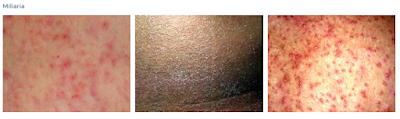
Common triggers include hot and humid environments (especially shortly after moving to a tropical climate), strenuous physical activity, febrile illness and occlusion of the skin.
Management
The rash is usually self-limited and resolves without medical intervention.The primary treatment for miliaria involves cooling and drying the affected areas and avoiding conditions that induce sweating.
- Avoid excessive heat when feasible (e.g. by limiting strenuous physical activity)
- Wear breathable clothing (such as cotton) that does not occlude the skin, and avoid excessive layers.
- Use air conditioning in hot and humid weather.
- Take frequent cool showers or baths using a mild soap
Once the rash develops, calamine lotion or a mild topical corticosteroid can be applied. Preparations containing menthol can also provide a soothing, cooling effect.
- Mild to mid-potency topical corticosteroids may be used to decrease pruritus (itching) and hasten the resolution of inflammation.
- Topical antiseptics or anti-staphylococcal antibiotics (e.g., clindamycin or erythromycin) may be indicated if a secondary bacterial infection occurs.
Comments
Post a Comment